
The Kalahari Typing School for Men

Originally published in July 2004, on my original 52 Books blog.
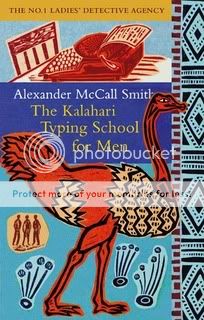
Author: Alexander McCall Smith
Year published: 2002
Genre: Literature, detective story
Where got: Public library

The story:
The agency has got some competition and Mma Ramotswe and her assistant/secretary Mma Makutsi are both worried about the future of the business. In order to make some extra money for herself, Mma Makutsi starts the business the book takes its title from, giving evening classes in typing to men, and one of her students falls in love with her. Meanwhile, Mma Ramotswe takes a case investigating whether a husband is cheating on his wife, and makes a disturbing discovery. Another client asks her to track down some people he hasn’t seen for about 20 years, so he can make restitution for things he did to them. Both cases present their own unique difficulties, but with her common sense and philosophical way of looking at things, Mma Ramotswe solves both cases to the satisfaction of all involved (except the cheating husband).

Rating:
A fourth instalment in the No. 1 Ladies Detective Agency series, and just as good as the others. 5 stars.

Comments

Geosi Reads said…
I really, really like the cover of this book. It makes me want to read it.

Popular posts from this blog

Icelandic folk-tale: The Laughing Merman

Icelanders not only believed in the existence of selkies, but also in mer-people. The mermaids were said to be very beautiful, while the mermen were supposed to be ugly as sin but very wise and able to see things others did not. O nce upon a time a farmer went out fishing and pulled up a merman. He tried to get the merman to talk to him but he would not answer, except to beg him to release him back into the sea, but this the farmer refused to do. The farmer rowed back to land, taking the captive merman with him. When he pulled up the boat on the shore, his wife came to him and greeted him with tenderness and kisses, which he received with pleasure. This made the merman laugh. Then the man’s dog came to him and greeted him tenderly in the way of dogs, by jumping up to him, but the farmer hit the dog. Again the merman laughed. Then the farmer walked up towards his house, but on the way he tripped over a tussock and hurt himself. He got angry and gave the tussock a good kicking. Then...

Book 7: Shadow of the Sun by Ryszard Kapuściński (reading notes)

-This reads like fiction - prose more beautiful than one has come to expect from non-fiction and many of the chapters are structured like fiction stories. There is little continuity between most of the chapters, although some of the narratives or stories spread over more than one chapter. This is therefore more a collection of short narratives than a cohesive entirety. You could pick it up and read the chapters at random and still get a good sense of what is going on. -Here is an author who is not trying to find himself, recover from a broken heart, set a record, visit 30 countries in 3 weeks or build a perfectly enviable home in a perfectly enviable location, which is a rarity within travel literature, but of course Kapuściński was in Africa to work, and not to travel for spiritual, mental or entertainment purposes (he was the Polish Press Agency's Africa correspondent for nearly 30 years). -I have no way of knowing how well Kapuściński knew Africa - I have never been there...

Bibliophile discusses Van Dine’s rules for writing detective stories

Writers have been putting down advice for wannabe writers for centuries, about everything from how to captivate readers to how to build a story and write believable characters to getting published. The mystery genre has had its fair share, and one of the best known advisory essays is mystery writer’s S.S. Van Dine’s 1928 piece “Twenty rules for writing detective stories.” I mentioned in one of my reviews that I might write about these rules. Well, I finally gave myself the time to do it. First comes the rule (condensed), then what I think about it. Here are the Rules as Van Dine wrote them . (Incidentally, check out the rest of this excellent mystery reader’s resource: Gaslight ) The rules are meant to apply to whodunnit amateur detective fiction, but the main ones can be applied to police and P.I. fiction as well. I will discuss them mostly in this context, but will also mention genres where the rules don’t apply and authors who have successfully and unsuccessfully broken the rules. 1...