Originally published in February 2005, in 2 parts.
Book 51 in my first 52 books challenge.
Slightly edited.
 Author and illustrator: Maryjo Koch
Year published: 1998
Pages: Not numbered
Genre: Art, nature study
Where got: Bookstore
I first came across Maryjo Koch’s nature study books on a visit to the USA. All four books, Bird Egg Feather Nest, Seed Leaf Flower Fruit, Pond Lake River Sea, and Dragonfly Beetle Butterfly Bee were available, but I had already spent all my shopping money on Christmas presents and decided to put them on my whish list and buy them later. Sadly, since then they have all gone out of print, which is why I was happy to find Seed Leaf Flower Fruit and Bird Egg Feather Nest at a second-hand store recently, in near perfect condition and at a great price. I bought them both. I had to flip a coin to decide which one I would review here. I hope I will be able to get my hands on the other two before too long. They come up occasionally in auctions on ebay, and I have every intention of aquiring them both.
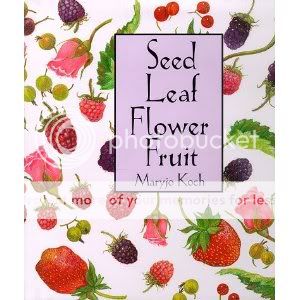
Seed Leaf Flower Fruit is a sumptuous collection of beautiful illustrations, information and thoughts about plants, all hand-lettered and looking like the sketch book of an artistically talented gardening enthusiast.
This is a gorgeous book, an eccentric, rambling and captivating nature study. As the title suggests, the theme is plants. Instead of concentrating on one aspect or type of plant life, Koch has chosen to go for the pick-and-mix method, and has produced a book that jumps from one plant type/species to the next, while still managing to convey the basics of plant biology in simple and concise language. The book is hand lettered, which may make it difficult for younger children to read, but children and adults of any age can enjoy the glorious pictures. The main text is written in capital block letters, while the names of plants and other things in the pictures are written in near-illegible longhand that sometimes is so faint that coupled with the bad handwriting it is almost impossible to read (probably a printing error). This is the only real complaint I have about the book.
Rating: A gorgeous book for nature and art lovers. 5+ stars.
Maryjo Koch's website
Book 51 in my first 52 books challenge.
Slightly edited.
Year published: 1998
Pages: Not numbered
Genre: Art, nature study
Where got: Bookstore
I first came across Maryjo Koch’s nature study books on a visit to the USA. All four books, Bird Egg Feather Nest, Seed Leaf Flower Fruit, Pond Lake River Sea, and Dragonfly Beetle Butterfly Bee were available, but I had already spent all my shopping money on Christmas presents and decided to put them on my whish list and buy them later. Sadly, since then they have all gone out of print, which is why I was happy to find Seed Leaf Flower Fruit and Bird Egg Feather Nest at a second-hand store recently, in near perfect condition and at a great price. I bought them both. I had to flip a coin to decide which one I would review here. I hope I will be able to get my hands on the other two before too long. They come up occasionally in auctions on ebay, and I have every intention of aquiring them both.
Seed Leaf Flower Fruit is a sumptuous collection of beautiful illustrations, information and thoughts about plants, all hand-lettered and looking like the sketch book of an artistically talented gardening enthusiast.
This is a gorgeous book, an eccentric, rambling and captivating nature study. As the title suggests, the theme is plants. Instead of concentrating on one aspect or type of plant life, Koch has chosen to go for the pick-and-mix method, and has produced a book that jumps from one plant type/species to the next, while still managing to convey the basics of plant biology in simple and concise language. The book is hand lettered, which may make it difficult for younger children to read, but children and adults of any age can enjoy the glorious pictures. The main text is written in capital block letters, while the names of plants and other things in the pictures are written in near-illegible longhand that sometimes is so faint that coupled with the bad handwriting it is almost impossible to read (probably a printing error). This is the only real complaint I have about the book.
Rating: A gorgeous book for nature and art lovers. 5+ stars.
Maryjo Koch's website
Comments