Originally published in September 2004, in 2 parts.
Book 30 in my first 52 books challenge.
Slightly edited for clarity.
 Author: Lucy Maud Montgomery
Year published: 1908
Pages: 280
Genre: Literature, classic, coming of age story
Where got: Amazon.co.uk
I was quite young when I discovered L.M. Montgomery’s Anne books. The first four books were translated into Icelandic a long time ago and my mother had all of them. I loved reading about Anne’s escapades and her growing up on Prince Edward Island. I was only allowed to read the first three books as a child, as my mother considered the subject matter of the fourth book to be too serious and beyond my childish understanding. I only got to read that book when I was in my teens and found it to be rather melodramatic.
This will be the first time I read any of the books in the original English, and it will be interesting to see how it compares with the translated text. In the past, some Icelandic translators and/or publishers had an unfortunate habit of removing blocks of text from translated books, and some translators even went as far as altering the text and even making some up. I dearly hope the Icelandic translations of the Anne stories are not among those books.
Part 2:
The Story:
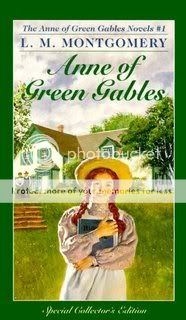
Middle-aged siblings Marilla and Matthew Cuthbert of Green Gables farm decide to adopt an orphan boy to help them with the farm work. What they get is Anne Shirley, a red-headed girl with an overactive imagination, a temperament as fiery as her hair, and a flair for getting herself in trouble. The book tells of Anne’s first years with the Cuthberts, the scrapes she is continually getting herself into, her friendship with Diana Barry and her war with Gilbert Blythe.
Technique and plot:
The book is full of wonderfully evocative descriptions of Prince Edward Island that make it sound like a paradise on earth (for all I know it may well have been at the time of writing). Anne’s exploits and other people’s reactions to her are described with gentle humour. The only thing I don’t like is Anne’s long speeches. They are certainly very funny at times, as Anne uses a rather literary language that is often inappropriate to the occasion and uses words you would not expect an adolescent girl to know, but I found myself skipping some of those passages because many of them are really just empty speech.
I last read this book about 10 years ago, in Icelandic. When I began reading I couldn’t remember a thing, but as I got into the story things started coming back to me and since the chapter headings are indicative of what happens, I sometimes would think ‘ahhh, here comes the time she got Diana drunk, here comes the time she broke her ankle’, etc. Rereading a much-loved book after so long a time is like visiting an old friend you haven’t seen in years, and finding she is still the same wonderful person you remembered.
Rating:
A wonderful classic story that has enchanted generations of readers, young and old. 5 stars.
Book 30 in my first 52 books challenge.
Slightly edited for clarity.
Year published: 1908
Pages: 280
Genre: Literature, classic, coming of age story
Where got: Amazon.co.uk
I was quite young when I discovered L.M. Montgomery’s Anne books. The first four books were translated into Icelandic a long time ago and my mother had all of them. I loved reading about Anne’s escapades and her growing up on Prince Edward Island. I was only allowed to read the first three books as a child, as my mother considered the subject matter of the fourth book to be too serious and beyond my childish understanding. I only got to read that book when I was in my teens and found it to be rather melodramatic.
This will be the first time I read any of the books in the original English, and it will be interesting to see how it compares with the translated text. In the past, some Icelandic translators and/or publishers had an unfortunate habit of removing blocks of text from translated books, and some translators even went as far as altering the text and even making some up. I dearly hope the Icelandic translations of the Anne stories are not among those books.
Part 2:
The Story:
Middle-aged siblings Marilla and Matthew Cuthbert of Green Gables farm decide to adopt an orphan boy to help them with the farm work. What they get is Anne Shirley, a red-headed girl with an overactive imagination, a temperament as fiery as her hair, and a flair for getting herself in trouble. The book tells of Anne’s first years with the Cuthberts, the scrapes she is continually getting herself into, her friendship with Diana Barry and her war with Gilbert Blythe.
Technique and plot:
The book is full of wonderfully evocative descriptions of Prince Edward Island that make it sound like a paradise on earth (for all I know it may well have been at the time of writing). Anne’s exploits and other people’s reactions to her are described with gentle humour. The only thing I don’t like is Anne’s long speeches. They are certainly very funny at times, as Anne uses a rather literary language that is often inappropriate to the occasion and uses words you would not expect an adolescent girl to know, but I found myself skipping some of those passages because many of them are really just empty speech.
I last read this book about 10 years ago, in Icelandic. When I began reading I couldn’t remember a thing, but as I got into the story things started coming back to me and since the chapter headings are indicative of what happens, I sometimes would think ‘ahhh, here comes the time she got Diana drunk, here comes the time she broke her ankle’, etc. Rereading a much-loved book after so long a time is like visiting an old friend you haven’t seen in years, and finding she is still the same wonderful person you remembered.
Rating:
A wonderful classic story that has enchanted generations of readers, young and old. 5 stars.
Comments
There are 8 books all in all, but the last three are more about Anne's children and the neighbour's children than about Anne.