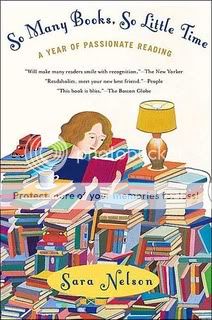
Bibliophilic Book Challenge: So Many Books, So Little Time by Sara Nelson

"Explaining the moment of connection between a reader and a book to someone who‘s never experienced it is like trying to explain sex to a virgin."
Sara Nelson on the phenomenon when a reader gets sucked into the book.

Bibliophilic book number 11. Only one to go. Not that I‘m counting ;-)

Year published:2003
Genre: Memoir

At the end of 2001, Sara Nelson decided to set herself a reading challenge, a simple book-a-week affair for one year, and keep a diary about it. The result was this book, which most readers should be able to, on some level, to enjoy. Although she is a seasoned, professional writer of book reviews, this is not a collection of reviews or even of literary theory or analysis, but more of a meditation on and a revelling in different aspects of reading, interspersed with snippets of information about whichever book she was reading at the time each essay was written.

She covers issues most readers will be familiar with, like trying to turn a non-reader into a reader, trying to raise a reader, the dangers of reading books recommended by friends and reviewing books by relatives, reading multiple books at a time, falling in love with an author, lending books, not wanting to follow the herd where best-sellers are concerned, and more.

This is not a flawless book, but enjoyable nonetheless. One of its faults is snobbery. It’s not widespread, but it’s there, for an example in the way romances published by a certain publishing giant are summarily dismissed as the lowest of the low, but weighing up against it is her frank admission that she simply doesn’t like some of the most critically well-received novels of the years before writing the book. I would have accepted her dismissal of romance novels as a simple matter of taste if she had rationalised it as eloquently as she did her dislike of the aforementioned critical successes, but she didn’t.

Another fault - more a sin, if you want my opinion - is that on a couple of occasions Nelson gives away the ending of books without indicating she is about to do so. Clearly someone forgot to hand her the memo about giving fair warning before giving away the ending if you want to stay in your readers' good books. Fortunately neither is a book I particularly want to read, but I have been enraged when I have come across and accidentally read such spoilers for books on my TBR list, so this big no-no still counts as a minus point.

As you may have noticed, this is an eminently quotable book – I have already given one quotation in a separate post, one in a reply to a comment and one at the beginning of his review, and I think I will end with one as well. But first the rating: A highly enjoyable book about the joys and pitfalls of reading. 4 stars.

"We’re a funny, cliquish group, we book people, and sometimes we resist liking—or even resist opening—the very thing everybody tells us we’re supposed to like."
Sara Nelson on her and some other readers' relationship with best-sellers and other "oh-my-God-you-must-read-this" books.

Comments

Popular posts from this blog

Book 7: Shadow of the Sun by Ryszard Kapuściński (reading notes)

-This reads like fiction - prose more beautiful than one has come to expect from non-fiction and many of the chapters are structured like fiction stories. There is little continuity between most of the chapters, although some of the narratives or stories spread over more than one chapter. This is therefore more a collection of short narratives than a cohesive entirety. You could pick it up and read the chapters at random and still get a good sense of what is going on. -Here is an author who is not trying to find himself, recover from a broken heart, set a record, visit 30 countries in 3 weeks or build a perfectly enviable home in a perfectly enviable location, which is a rarity within travel literature, but of course Kapuściński was in Africa to work, and not to travel for spiritual, mental or entertainment purposes (he was the Polish Press Agency's Africa correspondent for nearly 30 years). -I have no way of knowing how well Kapuściński knew Africa - I have never been there...

How to make a simple origami bookmark

Here are some instructions on how to make a simple origami (paper folding) bookmark: Take a square of paper. It can be patterned origami paper, gift paper or even office paper, just as long as it’s easy to fold. The square should not be much bigger than 10 cm/4 inches across, unless you intend to use the mark for a big book. The images show what the paper should look like after you follow each step of the instructions. The two sides of the paper are shown in different colours to make things easier, and the edges and fold lines are shown as black lines. Fold the paper in half diagonally (corner to corner), and then unfold. Repeat with the other two corners. This is to find the middle and to make the rest of the folding easier. If the paper is thick or stiff it can help to reverse the folds. Fold three of the corners in so that they meet in the middle. You now have a piece of paper resembling an open envelope. For the next two steps, ignore the flap. Fold the square diagonally in two. Yo...

Bibliophile discusses Van Dine’s rules for writing detective stories

Writers have been putting down advice for wannabe writers for centuries, about everything from how to captivate readers to how to build a story and write believable characters to getting published. The mystery genre has had its fair share, and one of the best known advisory essays is mystery writer’s S.S. Van Dine’s 1928 piece “Twenty rules for writing detective stories.” I mentioned in one of my reviews that I might write about these rules. Well, I finally gave myself the time to do it. First comes the rule (condensed), then what I think about it. Here are the Rules as Van Dine wrote them . (Incidentally, check out the rest of this excellent mystery reader’s resource: Gaslight ) The rules are meant to apply to whodunnit amateur detective fiction, but the main ones can be applied to police and P.I. fiction as well. I will discuss them mostly in this context, but will also mention genres where the rules don’t apply and authors who have successfully and unsuccessfully broken the rules. 1...