I read the first three books of Garth Nix's Old Kingdom series last year, after coming across an irresistibly priced boxed set of them in a charity shop. I loved them.
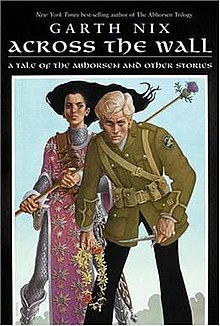
I couldn't really say which was my favourite, but I knew I wanted more and the ending of Abhorsen suggested there were more, so I did my research and got my mother to buy a copy of Goldenhand for me on one of her trips abroad. I then came across a second-hand copy of this book, Across the Wall, a collection of short stories by Nix, and knowing it contained a story that takes place between Abhorsen and Goldenhand, I promptly bought it. However, it took me a while to start reading it.
The stories are a varied collection and only the first, "Nicholas Sayre and the Creature in the Case" is an Old Kingdom story, so it was a fun introduction to Nix's other writing.
Nix seems to be first and foremost a children's and young adult writer, and from what I've read about him, the Old Kingdom series is the most mature of his writings within that label, but to tell the truth, I have rarely come across anything labelled 'young adult' that wasn't really just a book suitable for most ages - they just have teenaged or young adult protagonists. These stories are no exception.
As for the stories, they are varied and, as I said only one is an Old Kingdom story. The action in "The Creature in the Case" is similar to the action at the beginning of Sabriel, i.e. a race to prevent something evil from happening, in which many lives are lost and the protagonist gets to be a hero. This story is Nix's way of getting Nicholas Sayre back to the Old Kingdom (and Lirael - I can see a romance in the cards there). In Lirael, Nicholas nearly destroyed the Old Kingdom because of his refusal to believe in the existence of magic, but he was never evil, but rather first consumed with the earnest belief that he was doing good, and then under the thrall of evil. I expect he will fully redeem himself in Goldenhand.
The story is thrilling and fast paced and I really don't have much more to say about it.
I enjoyed most of the stories, and would be hard put to name a favourite, but I especially liked “The Hill”, “Lightning Bringer”, “Heart’s Desire” and “Hope Chest”.
I couldn't really say which was my favourite, but I knew I wanted more and the ending of Abhorsen suggested there were more, so I did my research and got my mother to buy a copy of Goldenhand for me on one of her trips abroad. I then came across a second-hand copy of this book, Across the Wall, a collection of short stories by Nix, and knowing it contained a story that takes place between Abhorsen and Goldenhand, I promptly bought it. However, it took me a while to start reading it.
The stories are a varied collection and only the first, "Nicholas Sayre and the Creature in the Case" is an Old Kingdom story, so it was a fun introduction to Nix's other writing.
Nix seems to be first and foremost a children's and young adult writer, and from what I've read about him, the Old Kingdom series is the most mature of his writings within that label, but to tell the truth, I have rarely come across anything labelled 'young adult' that wasn't really just a book suitable for most ages - they just have teenaged or young adult protagonists. These stories are no exception.
As for the stories, they are varied and, as I said only one is an Old Kingdom story. The action in "The Creature in the Case" is similar to the action at the beginning of Sabriel, i.e. a race to prevent something evil from happening, in which many lives are lost and the protagonist gets to be a hero. This story is Nix's way of getting Nicholas Sayre back to the Old Kingdom (and Lirael - I can see a romance in the cards there). In Lirael, Nicholas nearly destroyed the Old Kingdom because of his refusal to believe in the existence of magic, but he was never evil, but rather first consumed with the earnest belief that he was doing good, and then under the thrall of evil. I expect he will fully redeem himself in Goldenhand.
The story is thrilling and fast paced and I really don't have much more to say about it.
I enjoyed most of the stories, and would be hard put to name a favourite, but I especially liked “The Hill”, “Lightning Bringer”, “Heart’s Desire” and “Hope Chest”.
Comments