Marsh seems to have loved not only referring to and quoting books and plays, but she also made up titles, so there is plenty to work with in her books. The same titles crop up repeatedly, e.g. Macbeth, The Ingoldsby Legends and Jane Eyre.
 Publications:
Non-fiction:
Fiction:
Stage works:
 Stage works:
Publications:
Novels:
 Publications:
Plays:
Fiction:
Non-fiction:
Death in a White Tie:
 Publications:
- The Times - newspaper.
- The Evening Chronicle - newspaper.
- The Daily Express - newspaper.
- "guides to the turf" - no titles mentioned - racing guides.
Non-fiction:
- The principles and practice of medical jurisprudence by Alfred Swaine Taylor (as Taylor's Medical Jurisprudence) - what the title says.
- Imitation of Christ by Thomas à Kempis. Christian devotional.
- The Martyrdom of Man by William Winwood Reade. Philosophy/history.
Fiction:
- "paper-bound banned novels of a peculiar indecency and no literary merit whatsoever." - I couldn't resist quoting this, not only because it's a funny description of porn novels, but also because ownership of porn/erotica seems to be a sure mark of a cad - or worse - in Marsh's novels. Just witness Garnette's ownership of an unexpurgated edition of Petronius in Death in Ecstacy and Surbonadier's ownership of erotic art in Enter a Murderer.
- The Confessions of a Procuress - no author given. Porn or sensational novel. Probably imaginary.
- Jane Eyre by Charlotte Brontë. Novel.
- The Sherlock Holmes stories.
- The Ingoldsby Legends by Richard Harris Barham.Collection of myths, legends, ghost stories and poetry.
Stage works:
- The Face at the Window by Brooke Warren. Play. Actually, it's more likely that it's the film of the same title that's being referred to, but I'm giving it the benefit of the doubt.
- Macbeth - by Shakespeare. This play is mentioned in every other Marsh novel and it wouldn't surprise me if it was quoted in the others. The particular quotation mentioned in this one also appears in the next book.
Overture to Death
 Stage works:
- Ici on parle français; or, The major's mistake by Harold Roorbach. Play.
- Simple Susan. Play. Appears to be fictional, as I doubt it could be a play based on the Maria Edgeworth book, which was written for children.
- East Lynne - play, based on the sensation novel by Ellen Wood.
- The Silver King - play (melodrama) by Henry Arthur Jones and Henry Herman
- The Private Secretary - play (farce) by Sir Charles Henry Hawtrey.
- Shop Windows. Play by Jacob Hunt. Appears to be imaginary.
- Macbeth - play by Shakespeare.
- Twelfth Night - play by Shakespeare.
Publications:
- The Chipping Courier - newspaper. Imaginary.
- The Evening Mirror - newspaper.
- Bingo Bink's Weekly - periodical, appears to be imaginary.
Novels:
- The Ball and the Cross by G.K. Chesterton.
- Our Mutual Friend by Charles Dickens.
Death of a Peer, AKA Surfeit of Lampreys:
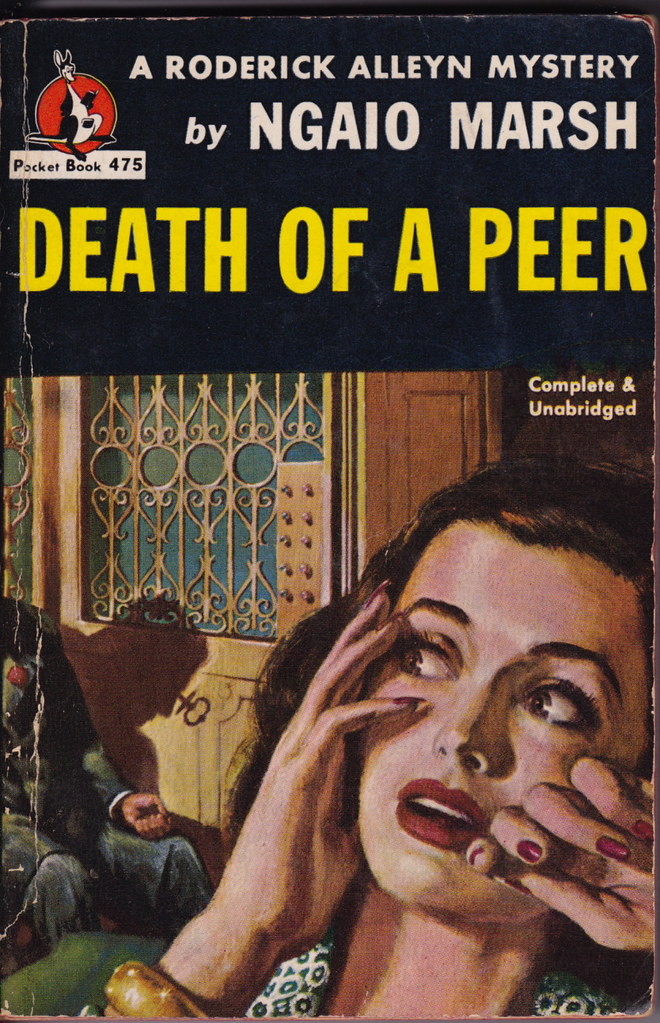 Publications:
 - The Spectator - magazine.
- Punch - humorous magazine.
- The Tatler - society magazine.
- The Standard - probably The Evening Standard. Newspaper.
- True Detective - crime and detective magazine.
Plays:
- Macbeth by Shakespeare (that makes three books in a row).
- The Comedy of Errors by Shakespeare.
Fiction:
- It Can't Happen Here by Sinclair Lewis. Novel.
- "The Case of the Severed Hand" There are a number of short stories out there dealing with severed hands, but the only one with this exact title I found online was written long after this novel. Even though I couldn't find the right story, I am certain this refers to a real story and not one Marsh invented.
- The Tale of Jemima Puddle-Duck by Beatrix Potter. Children's story with pictures.
Non-fiction:
- The Compendium Maleficarum (spelled Maleficorum in the book) - book of magic spells and witchcraft.
- The Ingoldsby Legends by Richard Harris Barham.Collection of myths, legends, ghost stories and poetry. (I think this is the third Marsh novel this book is mentioned in).
Comments
On another topic, I thought you might be interested in Esther Allen and Susan Bernofsky's new book: In Translation On their Work and What it Means (Columbia University Press).
Thanks for letting me know about the translation book. I will check it out.