
The ABC Murders by Agatha Christie

Originally published in June 2005, on my original 52 Books blog.
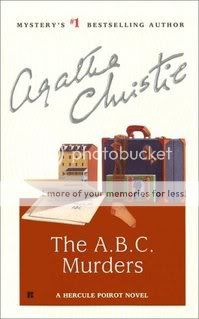
A clever killer sends taunting letters to Hercule Poirot, telling him dates and the names of towns where he intends to strike. The towns and the victims are alphabetical, A in Andover, and so on. Poirot agrees with the police that they are dealing with a psychopath, but he can not but feel that there is something wrong about the letters, something that doesn’t fit the profile of the killer they have deduced from his methods and choice of victims. So begins a cat and mouse game, but who is which? Regular Christie fans will be in no doubt as to who is the cat and who is the mouse, but may be surprised at a deviation from the Christie formula. Whether it is real or a red herring, I leave up to the reader to find out.

I admit to not being a Poirot fan - he annoys me too much, and I need to take breaks between the books about him, but this is quite a good Christie story. It is perhaps unfortunate that I have read so many of them that immediately upon reading the back cover blurb I figured out certain facts about the main plot twist, and knew who the killer was as soon as he appeared.

Rating: Christie dishes out murder with her usual gusto, Poirot annoys the reader, Hastings blunders on as usual. 3+ stars.

Comments

Yvette said…
I like this book more than you, but then I read it for the first time many MANY years ago when the killer came as a real surprise.

This method of hiding one murder within other unrelated murders is now call an 'abc murder' - thanks to Dame Agatha.

I love Poirot, fell in love with him when I was a teenager and never fell out. What that says about me, I don't know, but as I always say: it takes all kinds. Ha!
Bibliophile said…
I prefer Miss Marple - perhaps because she reminds me of my great aunt.

Popular posts from this blog

Book 7: Shadow of the Sun by Ryszard Kapuściński (reading notes)

-This reads like fiction - prose more beautiful than one has come to expect from non-fiction and many of the chapters are structured like fiction stories. There is little continuity between most of the chapters, although some of the narratives or stories spread over more than one chapter. This is therefore more a collection of short narratives than a cohesive entirety. You could pick it up and read the chapters at random and still get a good sense of what is going on. -Here is an author who is not trying to find himself, recover from a broken heart, set a record, visit 30 countries in 3 weeks or build a perfectly enviable home in a perfectly enviable location, which is a rarity within travel literature, but of course Kapuściński was in Africa to work, and not to travel for spiritual, mental or entertainment purposes (he was the Polish Press Agency's Africa correspondent for nearly 30 years). -I have no way of knowing how well Kapuściński knew Africa - I have never been there...

How to make a simple origami bookmark

Here are some instructions on how to make a simple origami (paper folding) bookmark: Take a square of paper. It can be patterned origami paper, gift paper or even office paper, just as long as it’s easy to fold. The square should not be much bigger than 10 cm/4 inches across, unless you intend to use the mark for a big book. The images show what the paper should look like after you follow each step of the instructions. The two sides of the paper are shown in different colours to make things easier, and the edges and fold lines are shown as black lines. Fold the paper in half diagonally (corner to corner), and then unfold. Repeat with the other two corners. This is to find the middle and to make the rest of the folding easier. If the paper is thick or stiff it can help to reverse the folds. Fold three of the corners in so that they meet in the middle. You now have a piece of paper resembling an open envelope. For the next two steps, ignore the flap. Fold the square diagonally in two. Yo...

Bibliophile discusses Van Dine’s rules for writing detective stories

Writers have been putting down advice for wannabe writers for centuries, about everything from how to captivate readers to how to build a story and write believable characters to getting published. The mystery genre has had its fair share, and one of the best known advisory essays is mystery writer’s S.S. Van Dine’s 1928 piece “Twenty rules for writing detective stories.” I mentioned in one of my reviews that I might write about these rules. Well, I finally gave myself the time to do it. First comes the rule (condensed), then what I think about it. Here are the Rules as Van Dine wrote them . (Incidentally, check out the rest of this excellent mystery reader’s resource: Gaslight ) The rules are meant to apply to whodunnit amateur detective fiction, but the main ones can be applied to police and P.I. fiction as well. I will discuss them mostly in this context, but will also mention genres where the rules don’t apply and authors who have successfully and unsuccessfully broken the rules. 1...