Used & Rare and Slightly Chipped by Lawrence and Nancy Goldstone

Originally published in April 2005, on my original 52 Books blog.


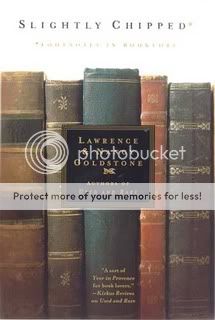
I read these two books by Lawrence and Nancy Goldstone one after the other. The first, Used and Rare: Travels in the book world, is about why and how they started accumulating a library of used books, how they gradually began to understand the language of book collecting and recognise the value of books, and how their collecting escalated until they were buying expensive first editions, and how they finally came to their senses and decided it was more important to get good reading copies of many favourite books than to spend thousands of dollars on a few first editions.
This is a charming book about the development of a hobby that the authors show can be both affordable and enjoyable, even for people of modest income, as long as they don’t get carried away with first edition fever.

The second book, Slightly Chipped: Footnotes in booklore, which on the dust jacket is somewhat pretentiously called a “companion piece” to the previous book (it is fact an ordinary sequel), is about their continuing interest in books, friendships made through book-collecting, and adventures, such as when they attended the Edgars (mystery book awards) and the auction of the estate of the Duke and Duchess of Windsor. This book is padded with pages upon pages of information about authors and book trivia, and one gets the impression that it was written in haste. Some of the charm of the previous book is still there, but this book is not as solid a piece of work.

Note:
Call me grumpy, but I thought books had to be proofread before going into printing. I have never in my book-reading life come across as many typing and spelling errors in any book as I have in those two, errors that any decent computer proofing tool would have found. It is all the worse in book one because it is not a first edition and someone should have corrected the spelling errors before it went into paperback.
The second book has rather fewer proofing errors, but the ones that there are, are much worse, terrible typing errors that have gone unnoticed at the proofing stage. Of course, should this book ever become collectible, this will probably make the first printing of the first edition more valuable, but that is no consolation to the poor reader who has to put up with the errors. For this reason I am withholding one star from each book, and giving Used and Rare 3 stars and Slightly Chipped 2 stars.

Comments

Dorte H said…
I don´t think you are grumpy, but perhaps I am a tad spiteful because I enjoyed a note about a book from a ´proper publisher´ being less than perfect. It may be true that too many self-published books are of poor quality, but it seems that the problem is more widespread than that ;)
Bibliophile said…
Oh, definitely.
I can only imagine what the manuscripts were like if that many errors crept into the published edition.
Bibliophile said…
Oh, definitely.
I can only imagine what the manuscripts were like if that many errors crept into the published edition.

Popular posts from this blog

Book 7: Shadow of the Sun by Ryszard Kapuściński (reading notes)

-This reads like fiction - prose more beautiful than one has come to expect from non-fiction and many of the chapters are structured like fiction stories. There is little continuity between most of the chapters, although some of the narratives or stories spread over more than one chapter. This is therefore more a collection of short narratives than a cohesive entirety. You could pick it up and read the chapters at random and still get a good sense of what is going on. -Here is an author who is not trying to find himself, recover from a broken heart, set a record, visit 30 countries in 3 weeks or build a perfectly enviable home in a perfectly enviable location, which is a rarity within travel literature, but of course Kapuściński was in Africa to work, and not to travel for spiritual, mental or entertainment purposes (he was the Polish Press Agency's Africa correspondent for nearly 30 years). -I have no way of knowing how well Kapuściński knew Africa - I have never been there...

How to make a simple origami bookmark

Here are some instructions on how to make a simple origami (paper folding) bookmark: Take a square of paper. It can be patterned origami paper, gift paper or even office paper, just as long as it’s easy to fold. The square should not be much bigger than 10 cm/4 inches across, unless you intend to use the mark for a big book. The images show what the paper should look like after you follow each step of the instructions. The two sides of the paper are shown in different colours to make things easier, and the edges and fold lines are shown as black lines. Fold the paper in half diagonally (corner to corner), and then unfold. Repeat with the other two corners. This is to find the middle and to make the rest of the folding easier. If the paper is thick or stiff it can help to reverse the folds. Fold three of the corners in so that they meet in the middle. You now have a piece of paper resembling an open envelope. For the next two steps, ignore the flap. Fold the square diagonally in two. Yo...

Bibliophile discusses Van Dine’s rules for writing detective stories

Writers have been putting down advice for wannabe writers for centuries, about everything from how to captivate readers to how to build a story and write believable characters to getting published. The mystery genre has had its fair share, and one of the best known advisory essays is mystery writer’s S.S. Van Dine’s 1928 piece “Twenty rules for writing detective stories.” I mentioned in one of my reviews that I might write about these rules. Well, I finally gave myself the time to do it. First comes the rule (condensed), then what I think about it. Here are the Rules as Van Dine wrote them . (Incidentally, check out the rest of this excellent mystery reader’s resource: Gaslight ) The rules are meant to apply to whodunnit amateur detective fiction, but the main ones can be applied to police and P.I. fiction as well. I will discuss them mostly in this context, but will also mention genres where the rules don’t apply and authors who have successfully and unsuccessfully broken the rules. 1...