Buchmesse Challenge review for February: The Fish Can Sing by Halldór Laxness

Icelandic title: Brekkukotsannáll (Literally “Annals of Brekkukot”) 
Genre: Literary fiction, historical
Year of publication: 1957
Setting & time: Reykjavik area, Iceland; beginning of the 20th century.

This novel by Iceland's only Nobel prize-winner, the first he published after winning the prize, boasts what is the most memorable opening sentence I have ever read in a novel:

"A wise man once said that next to losing its mother, there is nothing more healthy for a child than to lose its father."


Álfgrímur (the narrator of the story) is a young boy abandoned by his mother and raised by his foster-grandparents at Brekkukot, a small house in what is now nearly the center of Reykjavik but was, at the time of the story, one of a small cluster of buildings separate from the commercial and administrative center of town. The house is a haven for people who are down on their luck and acts as a sort of social center for the community and a counterpoint for the bakery which becomes the other centre of Álfgrímur’s life. His plans to become a fisherman begin to change when Garðar Hólm, a world-famous Icelandic singer (who may or may not be anything of the sort), returns to his homeland and awakens Álfgrímur’s interest in singing, but also brings about his inevitable loss of innocence.
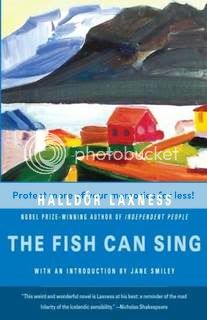
I vacillated between reviewing a new (to me) Laxness novel and one I had read before for this challenge, but finally I decided to choose one of my two Laxness favourites, Iceland’s Bell (Íslandsklukkan) or The Fish Can Sing (Brekkukotsannáll). I eventually decided to write about The Fish Can Sing, since it takes place during an era of history that I am interested in. The belle epoque was in full swing in Europe, but while it covers a belle epoque of sorts in the life of the narrator the story of The Fish Can Sing couldn't in other respects be farther away from the grand flowering of culture and science that was taking place across the sea.

The Fish Can Sing is first and foremost a lovely coming of age novel with all the contrasting of experience vs. innocence (and the loss thereof) that this entails, but it is also a mediation on the difference between the pastoral and the cosmopolitan and a somewhat nostalgic snapshot of a less complicated era that is forever gone. On the surface it is a simple story, but there is much going on under that surface. The narrative is more character-driven than plot-based, the prose is simple, beautiful and unpretentious (which can unfortunately not be said of all of Laxness’ novels), and while it hasn’t received the attention that Independent People has, it is thought by some to be Laxness’ true masterpiece. 5 stars.

Below you will find a list of languages it has been translated into,latest edition given in all cases. Some are lamentably translations of translations, but at least the German and Scandinavian editions are translated from the original Icelandic.

Arabic (Hin Tghni Ala'smak; Lebanon, 2010)
Bulgarian (Letopis Na Stopanstvoto Brekukot; 1964)
Czech (Rybí Koncert; 1978)
Danish (År Og Dage I Brattekåd; 1973)
Dutch (Het Visconcert; 2004)
Finnish (Lapsuuden Maisema; 1960
German (Das Fischkonzert; 2002)
Greenlandic (Aallartup Allattugai; 1984)
Hebrew (Gam Ha-Dag Yasir; 1976)
Hungarian (Az Éneklö Hal; 1962)
Italian (Il Concerto Dei Pesci; 2007)
Norwegian (Brekkukotkrønike; 2000)
Polish (Czysty Ton; 1966)
Portugese (Os Peixes Também Sabem Cantar; 2010)
Russian (Brekkukotskaja Letopis, 1954)
Swedish (Tidens Gång I Backstugan; 1967)


Comments

Popular posts from this blog

Book 7: Shadow of the Sun by Ryszard Kapuściński (reading notes)

-This reads like fiction - prose more beautiful than one has come to expect from non-fiction and many of the chapters are structured like fiction stories. There is little continuity between most of the chapters, although some of the narratives or stories spread over more than one chapter. This is therefore more a collection of short narratives than a cohesive entirety. You could pick it up and read the chapters at random and still get a good sense of what is going on. -Here is an author who is not trying to find himself, recover from a broken heart, set a record, visit 30 countries in 3 weeks or build a perfectly enviable home in a perfectly enviable location, which is a rarity within travel literature, but of course Kapuściński was in Africa to work, and not to travel for spiritual, mental or entertainment purposes (he was the Polish Press Agency's Africa correspondent for nearly 30 years). -I have no way of knowing how well Kapuściński knew Africa - I have never been there...

How to make a simple origami bookmark

Here are some instructions on how to make a simple origami (paper folding) bookmark: Take a square of paper. It can be patterned origami paper, gift paper or even office paper, just as long as it’s easy to fold. The square should not be much bigger than 10 cm/4 inches across, unless you intend to use the mark for a big book. The images show what the paper should look like after you follow each step of the instructions. The two sides of the paper are shown in different colours to make things easier, and the edges and fold lines are shown as black lines. Fold the paper in half diagonally (corner to corner), and then unfold. Repeat with the other two corners. This is to find the middle and to make the rest of the folding easier. If the paper is thick or stiff it can help to reverse the folds. Fold three of the corners in so that they meet in the middle. You now have a piece of paper resembling an open envelope. For the next two steps, ignore the flap. Fold the square diagonally in two. Yo...

Bibliophile discusses Van Dine’s rules for writing detective stories

Writers have been putting down advice for wannabe writers for centuries, about everything from how to captivate readers to how to build a story and write believable characters to getting published. The mystery genre has had its fair share, and one of the best known advisory essays is mystery writer’s S.S. Van Dine’s 1928 piece “Twenty rules for writing detective stories.” I mentioned in one of my reviews that I might write about these rules. Well, I finally gave myself the time to do it. First comes the rule (condensed), then what I think about it. Here are the Rules as Van Dine wrote them . (Incidentally, check out the rest of this excellent mystery reader’s resource: Gaslight ) The rules are meant to apply to whodunnit amateur detective fiction, but the main ones can be applied to police and P.I. fiction as well. I will discuss them mostly in this context, but will also mention genres where the rules don’t apply and authors who have successfully and unsuccessfully broken the rules. 1...