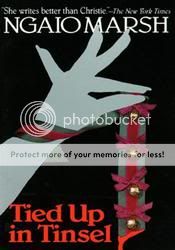
Mystery review: Tied up in Tinsel by Ngaio Marsh

Year of publication: 1972
Series and no.: Inspector Roderick Alleyn (Detective superintendent in this book), no. 27/32
Genre: Country murder house mystery
Setting & time: England, contemporary

Agatha Troy, Roderick Alleyn’s famous painter wife, is at a country house to paint the owner’s portrait. As Alleyn is working on an extradition case in Australia, she accepts an invitation to spend Christmas there (there is no mention of her son, Ricky, which I find strange). Then a servant disappears under suspicious circumstances just after Alleyn has returned and accepted an invitation to join the house party over Christmas. Although the investigation of the case rightfully belongs to the local police, the master of the house is able to force Alleyn to take over the investigation, which he reluctantly does.

When I read this book I found myself getting irked at some discrepancies in the story when compared with the previous books. Alleyn, who has hitherto not hesitated to poke his nose into cases that are really no concern of his – such as in the last book before this one – is in this one strangely reluctant to take over this case and in fact gets quite stroppy when forced into it. And when I saw a date that fixed the time period in which this story takes place I found myself going “oh, no!” because it is contemporary with the publication date, which would mean that Alleyn is still working as a police officer in his mid-to-late seventies, but with all the prowess of a man in his forties. Much better to have only alluded to the time period and continued in the timeless vein, in my opinion.

Apart from these little details, this is quite a good mystery. Marsh creates an atmosphere of tension and hostility, partly with the cast of characters and partly by setting the story in the middle of winter with miserable weather. She leads the reader astray with ease and well-planted red herrings and I would say she manages quite deftly to draw attention away from a key clue that is dropped quite early in the story. I know that if I hadn’t been wearing my sleuthing glasses I would certainly have missed it. As it was, it still took a couple of chapters before I realised what was going on. After that it was just a matter of seeing how Alleyn solved it. 4 stars.

Awards: Finalist 1973 Edgar Award for Best Mystery

Comments

Dorte H said…
I do enjoy a Ngaio Marsh once in a while so I just checked Amazon.com. But I don´t think an e-book like this should cost $ 11 so I´ll wait for a used copy.
Bibliophile said…
$11? That's daylight robbery with mugging thrown in for good measure.

Popular posts from this blog

Book 7: Shadow of the Sun by Ryszard Kapuściński (reading notes)

-This reads like fiction - prose more beautiful than one has come to expect from non-fiction and many of the chapters are structured like fiction stories. There is little continuity between most of the chapters, although some of the narratives or stories spread over more than one chapter. This is therefore more a collection of short narratives than a cohesive entirety. You could pick it up and read the chapters at random and still get a good sense of what is going on. -Here is an author who is not trying to find himself, recover from a broken heart, set a record, visit 30 countries in 3 weeks or build a perfectly enviable home in a perfectly enviable location, which is a rarity within travel literature, but of course Kapuściński was in Africa to work, and not to travel for spiritual, mental or entertainment purposes (he was the Polish Press Agency's Africa correspondent for nearly 30 years). -I have no way of knowing how well Kapuściński knew Africa - I have never been there...

Bibliophile discusses Van Dine’s rules for writing detective stories

Writers have been putting down advice for wannabe writers for centuries, about everything from how to captivate readers to how to build a story and write believable characters to getting published. The mystery genre has had its fair share, and one of the best known advisory essays is mystery writer’s S.S. Van Dine’s 1928 piece “Twenty rules for writing detective stories.” I mentioned in one of my reviews that I might write about these rules. Well, I finally gave myself the time to do it. First comes the rule (condensed), then what I think about it. Here are the Rules as Van Dine wrote them . (Incidentally, check out the rest of this excellent mystery reader’s resource: Gaslight ) The rules are meant to apply to whodunnit amateur detective fiction, but the main ones can be applied to police and P.I. fiction as well. I will discuss them mostly in this context, but will also mention genres where the rules don’t apply and authors who have successfully and unsuccessfully broken the rules. 1...

List love: 10 recommended stories with cross-dressing characters

This trope is almost as old as literature, what with Achilles, Hercules and Athena all cross-dressing in the Greek myths, Thor and Odin disguising themselves as women in the Norse myths, and Arjuna doing the same in the Mahabaratha. In modern times it is most common in romance novels, especially historicals in which a heroine often spends part of the book disguised as a boy, the hero sometimes falling for her while thinking she is a boy. Occasionally a hero will cross-dress, using a female disguise to avoid recognition or to gain access to someplace where he would never be able to go as a man. However, the trope isn’t just found in romances, as may be seen in the list below, in which I recommend stories with a variety of cross-dressing characters. Unfortunately I was only able to dredge up from the depths of my memory two book-length stories I had read in which men cross-dress, so this is mostly a list of women dressed as men. Ghost Riders by Sharyn McCrumb. One of the interwove...