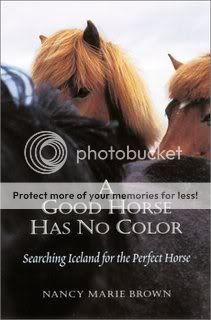
A Good Horse Has No Color: Searching Iceland for the Perfect Horse by Nancy Marie Brown

Genre: Non-fiction, memoir/travelogue
Year of publication: 2001
Setting & time: Iceland; 1996 and 1997

Nancy Marie Brown and her husband, writer Charles Fergus, came to Iceland with their young son to spend the summer of 1996 while still reeling from a family tragedy. Fergus recounted the story of their stay there in Summer at Little Lava, which I reviewed some years ago. I reposted the review yesterday.

When I became aware that Nancy was also a writer, I decided to read one of her books and of the two available in the National Library, I chose this one, as to me it’s the more interesting of the two. In a way it picks up from where Fergus left off, showing how Nancy fell in love with the Icelandic horse breed and returned to Iceland a year later determined to buy a couple of horses of her own and take them home to Pennsylvania. She recounts her adventures and experiences among Icelandic horse people (a unique breed in themselves) and her search for the perfect horse (for her) and sprinkles in references to Icelandic folklore, Nordic mythology and the Sagas.

This is an honest and very readable account by a woman who feels very much like a fish out of water among people who have been riding horses all their lives, some since before they could walk, and some of the pitfalls of horse-buying. There are a few cautionary accounts of crooked horse-dealing in the book (including a couple of quite funny ones), but she seems to have been able to avoid most of the pitfalls, even the one the book’s title refers to: the temptation to buy a horse because just you like its colour. Most of all this is a story about self-discovery and learning.

Quite apart from being an enjoyable memoir/travelogue, this book could make interesting reading for a person studying business since it covers, in detail, the entire classic model of the consumer buying process from beginning to end.
3+ stars.


Click here to read a short excerpt
.

Comments

Popular posts from this blog

Book 7: Shadow of the Sun by Ryszard Kapuściński (reading notes)

-This reads like fiction - prose more beautiful than one has come to expect from non-fiction and many of the chapters are structured like fiction stories. There is little continuity between most of the chapters, although some of the narratives or stories spread over more than one chapter. This is therefore more a collection of short narratives than a cohesive entirety. You could pick it up and read the chapters at random and still get a good sense of what is going on. -Here is an author who is not trying to find himself, recover from a broken heart, set a record, visit 30 countries in 3 weeks or build a perfectly enviable home in a perfectly enviable location, which is a rarity within travel literature, but of course Kapuściński was in Africa to work, and not to travel for spiritual, mental or entertainment purposes (he was the Polish Press Agency's Africa correspondent for nearly 30 years). -I have no way of knowing how well Kapuściński knew Africa - I have never been there...

Bibliophile discusses Van Dine’s rules for writing detective stories

Writers have been putting down advice for wannabe writers for centuries, about everything from how to captivate readers to how to build a story and write believable characters to getting published. The mystery genre has had its fair share, and one of the best known advisory essays is mystery writer’s S.S. Van Dine’s 1928 piece “Twenty rules for writing detective stories.” I mentioned in one of my reviews that I might write about these rules. Well, I finally gave myself the time to do it. First comes the rule (condensed), then what I think about it. Here are the Rules as Van Dine wrote them . (Incidentally, check out the rest of this excellent mystery reader’s resource: Gaslight ) The rules are meant to apply to whodunnit amateur detective fiction, but the main ones can be applied to police and P.I. fiction as well. I will discuss them mostly in this context, but will also mention genres where the rules don’t apply and authors who have successfully and unsuccessfully broken the rules. 1...

Book 40: The Martian by Andy Weir, audiobook read by Wil Wheaton

Note : This will be a general scattershot discussion about my thoughts on the book and the movie, and not a cohesive review. When movies are based on books I am interested in reading but haven't yet read, I generally wait to read the book until I have seen the movie, but when a movie is made based on a book I have already read, I try to abstain from rereading the book until I have seen the movie. The reason is simple: I am one of those people who can be reduced to near-incoherent rage when a movie severely alters the perfectly good story line of a beloved book, changes the ending beyond recognition or adds unnecessarily to the story ( The Hobbit , anyone?) without any apparent reason. I don't mind omissions of unnecessary parts so much (I did not, for example, become enraged to find Tom Bombadil missing from The Lord of the Rings ), because one expects that - movies based on books would be TV-series long if they tried to include everything, so the material must be pared down ...