
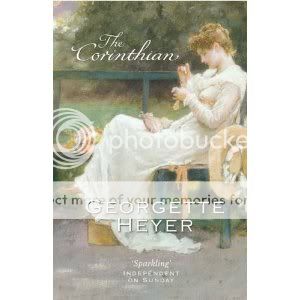
The Corinthian by Georgette Heyer

Originally published in May 2005, on my original 52 Books blog.

This is a delightful Regency romance from the mother of the genre, Georgette Heyer. It should perhaps rather be classified as a historical novel with a romantic twist, because, like in all the Heyer novels I have read so far, the romantic element doesn’t come in until about 3/4 of the way into the story and takes second place to adventure. All the way through it is a delightful romp with a plot that would not feel out of place in a Shakespearian comedy.

Sir Richard Wyndham, dandy and sportsman supreme, is about to give in to family pressure and marry a young woman who only wants him because he’s rich and can get her family out of financial trouble. As he walks from his club one night, slightly the worse for drink (as they would have put it back in those days), he sees a young woman, dressed as a boy, struggling to climb out a window. She turns out to be the Honourable Miss Penelope Creed, an heiress who is attempting to escape the house of her aunt, who is trying to force Penelope into marriage with her odious son. Richard decides to help her escape, and accompanies her to the country where she has another aunt whose son she intends to marry. To avoid detection, they travel by stagecoach, Penelope still dressed as a boy, and pretending Richard is her tutor. What awaits them is adventure in the form of stolen diamonds, low characters, murder, and a pair of lovers in desperate need of help.

A great combination of adventure, romance and historical detail. 4 stars.
Comments

Yvette said…
LOVED this book. I read this right after Heyer's THE TALISMAN RING and was just in seventh heaven.

Wrote about them on my blog a while back.

What fun books.

I'm definitely going to be reading more Heyer.

Popular posts from this blog

Book 7: Shadow of the Sun by Ryszard Kapuściński (reading notes)

-This reads like fiction - prose more beautiful than one has come to expect from non-fiction and many of the chapters are structured like fiction stories. There is little continuity between most of the chapters, although some of the narratives or stories spread over more than one chapter. This is therefore more a collection of short narratives than a cohesive entirety. You could pick it up and read the chapters at random and still get a good sense of what is going on. -Here is an author who is not trying to find himself, recover from a broken heart, set a record, visit 30 countries in 3 weeks or build a perfectly enviable home in a perfectly enviable location, which is a rarity within travel literature, but of course Kapuściński was in Africa to work, and not to travel for spiritual, mental or entertainment purposes (he was the Polish Press Agency's Africa correspondent for nearly 30 years). -I have no way of knowing how well Kapuściński knew Africa - I have never been there...

How to make a simple origami bookmark

Here are some instructions on how to make a simple origami (paper folding) bookmark: Take a square of paper. It can be patterned origami paper, gift paper or even office paper, just as long as it’s easy to fold. The square should not be much bigger than 10 cm/4 inches across, unless you intend to use the mark for a big book. The images show what the paper should look like after you follow each step of the instructions. The two sides of the paper are shown in different colours to make things easier, and the edges and fold lines are shown as black lines. Fold the paper in half diagonally (corner to corner), and then unfold. Repeat with the other two corners. This is to find the middle and to make the rest of the folding easier. If the paper is thick or stiff it can help to reverse the folds. Fold three of the corners in so that they meet in the middle. You now have a piece of paper resembling an open envelope. For the next two steps, ignore the flap. Fold the square diagonally in two. Yo...

Bibliophile discusses Van Dine’s rules for writing detective stories

Writers have been putting down advice for wannabe writers for centuries, about everything from how to captivate readers to how to build a story and write believable characters to getting published. The mystery genre has had its fair share, and one of the best known advisory essays is mystery writer’s S.S. Van Dine’s 1928 piece “Twenty rules for writing detective stories.” I mentioned in one of my reviews that I might write about these rules. Well, I finally gave myself the time to do it. First comes the rule (condensed), then what I think about it. Here are the Rules as Van Dine wrote them . (Incidentally, check out the rest of this excellent mystery reader’s resource: Gaslight ) The rules are meant to apply to whodunnit amateur detective fiction, but the main ones can be applied to police and P.I. fiction as well. I will discuss them mostly in this context, but will also mention genres where the rules don’t apply and authors who have successfully and unsuccessfully broken the rules. 1...